
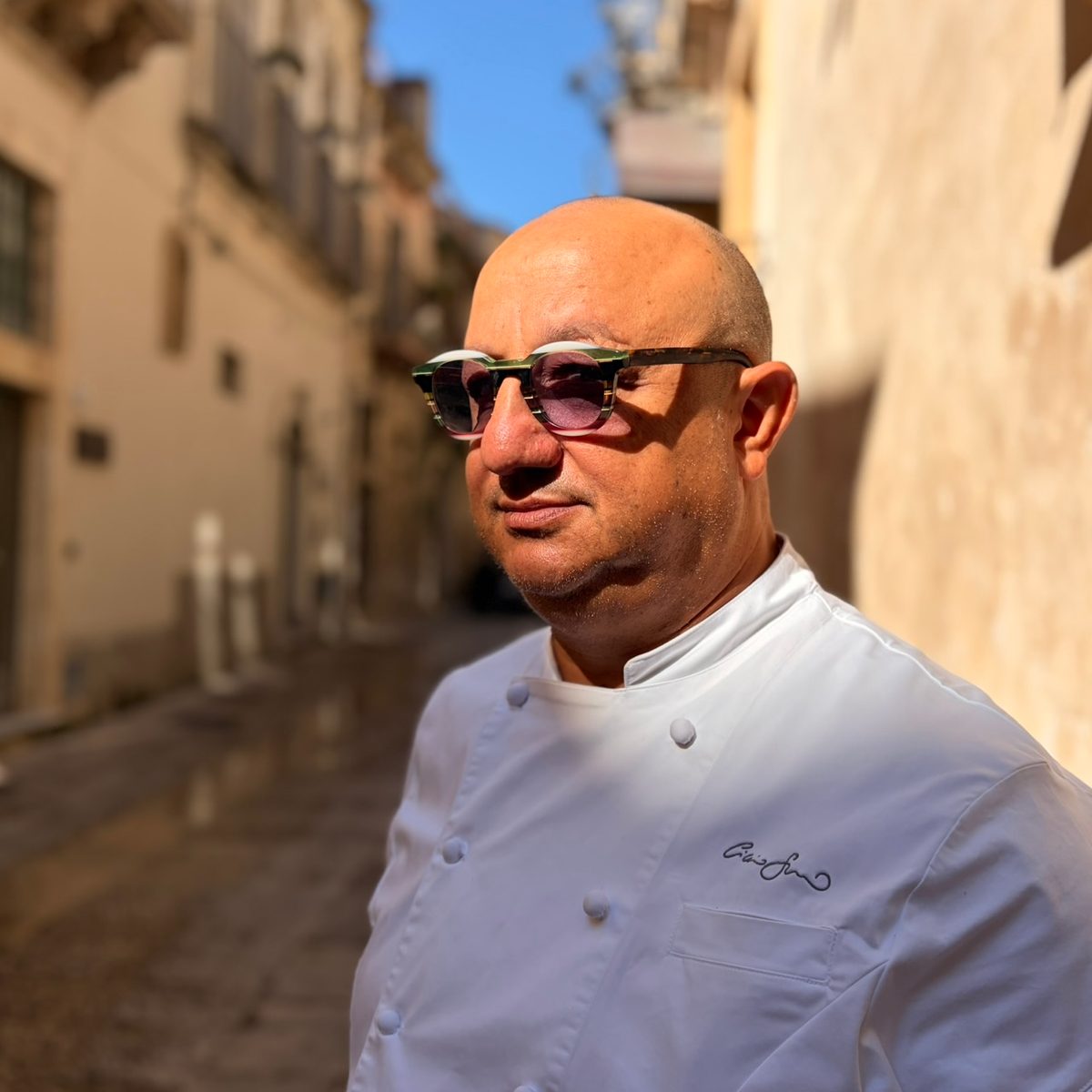
Interview with Ciccio Sultano, chef of Ristorante Duomo in Ragusa Ibla
Ciccio Sultano, chef at the helm of Ristorante Duomo in Ragusa Ibla for 26 years and holder of two Michelin stars, has turned the Sicilian landscape into a universal language. He is one of the most influential figures on the Italian gastronomic scene. We met him in the heart of Ragusa Ibla to talk about creativity, raw ingredients and the place of vanilla, among many other ingredients, in his cooking.
Eurovanille
After 26 years at Duomo, what still fuels your creativity?
Ciccio SultanoCreativity is a mathematical equation. It is something you have to keep nourishing. You need to surround yourself with people for whom creation matters, with artists, not necessarily chefs. There is also reading, silence, moments of leisure. Distraction is one of the most important elements of creativity: to let yourself be distracted is to know how to switch off so that you can then create.
I picture creativity as a multitude of seeds: ideas, ingredients, fragments of history, stories from the past, the history of Sicily, novels.
Eurovanille
You are often described as a “transformer” of raw ingredients. Do you recognise yourself in that term?
Ciccio SultanoI am not a transformer. Perhaps I feel more like a catalyst: of ideas, of ingredients, of people.
When I create a recipe, I look for noise and silence, those moments of rupture that give it movement. The ingredient must always remain itself. You can work it, ferment it, turn it into a cream, but you must never forget what it is.
The stylistic exercise, the kind that puts the chef in the spotlight at the expense of the ingredient, ends up stifling the raw ingredient. That is precisely what must be avoided.
Eurovanille
What do you look for in a raw ingredient that makes you want to work with it?
Ciccio SultanoI am not looking for rare ingredients. I am looking for rare ideas.
Take salt. It is perhaps the most ordinary ingredient of all, the one we always have within reach. And yet we only truly grasp its importance when it runs out. Wars have been fought over salt. In Africa, even today, it can serve as a currency. The word “salary” itself comes from salt.
For me, everything depends on the idea you build around the ingredient. It is not the rare ingredient that makes a person unique, it is the rare idea.
Eurovanille
What is your first memory of vanilla?
Ciccio SultanoI started working in a pastry shop at thirteen. For me, vanilla takes me back to childhood.
In my early days in pastry, between the crème pâtissière, the croissants and everything else we made, vanilla was part of my daily life. To me, it evokes something deeply childlike, pure, almost virginal.
Eurovanille
What place does vanilla hold in your cooking today?
Ciccio SultanoIn Sicilian cuisine, as I see it, vanilla is a spice. And, like every spice, it has nuances that you have to learn to read.
Tahiti vanilla is more sensual, more voluptuous, more floral. I can easily picture it in savoury dishes, with pasta or with lamb. Bourbon vanilla is more powerful, with notes of hazelnut and a more earthy character. I associate it more with milk, creams and cakes.
At Duomo, for example, we serve the Pasta Talisker: a preparation based on a double sour cream, generously worked with Tahiti vanilla. It belongs to what we call “desserts that are not quite desserts”, on the border between sweet and savoury.
Vanilla then cuts across the dish like a blade: it heightens the presence of the ingredient.
Eurovanille
And what about the other ingredients you use (saffron, tonka beans, citrus extracts)? Does the same logic apply?
Ciccio SultanoYes. These ingredients must keep their purity and their power, from the way they are grown to the way they are used. There has to be a continuity between the person who cultivates the land and respects the raw material, and our restaurant, where that material becomes a recipe.
In Sicily, there is a saying: when the sea is too rough and there is no fish, you eat “pasta with sardines, without the sardines”. In my version, adding sugar and vanilla tips into dessert what originally belonged to the savoury side.
What I call the “citric” side of these ingredients (saffron, vanilla, tonka bean), which for me is not simply a scent of lemon, acts as a catalyst. It gives the recipe a lift, energy, a spark.
Eurovanille
What would an ingredient need to have to still surprise you?
Ciccio SultanoI do not think these ingredients need to change. On the contrary: we should strive to express better the concentration and the aromas they already possess.
Surprise does not come from the ingredient itself. It comes from the idea you build around it. I am not looking for rare ingredients: it is the rare idea that creates uniqueness.
Beauty, determination, self-sacrifice: these are all elements that shape the way we are.
And to young people, to the new generations, I would say: make use of boredom to create more, rather than running away from it.


