

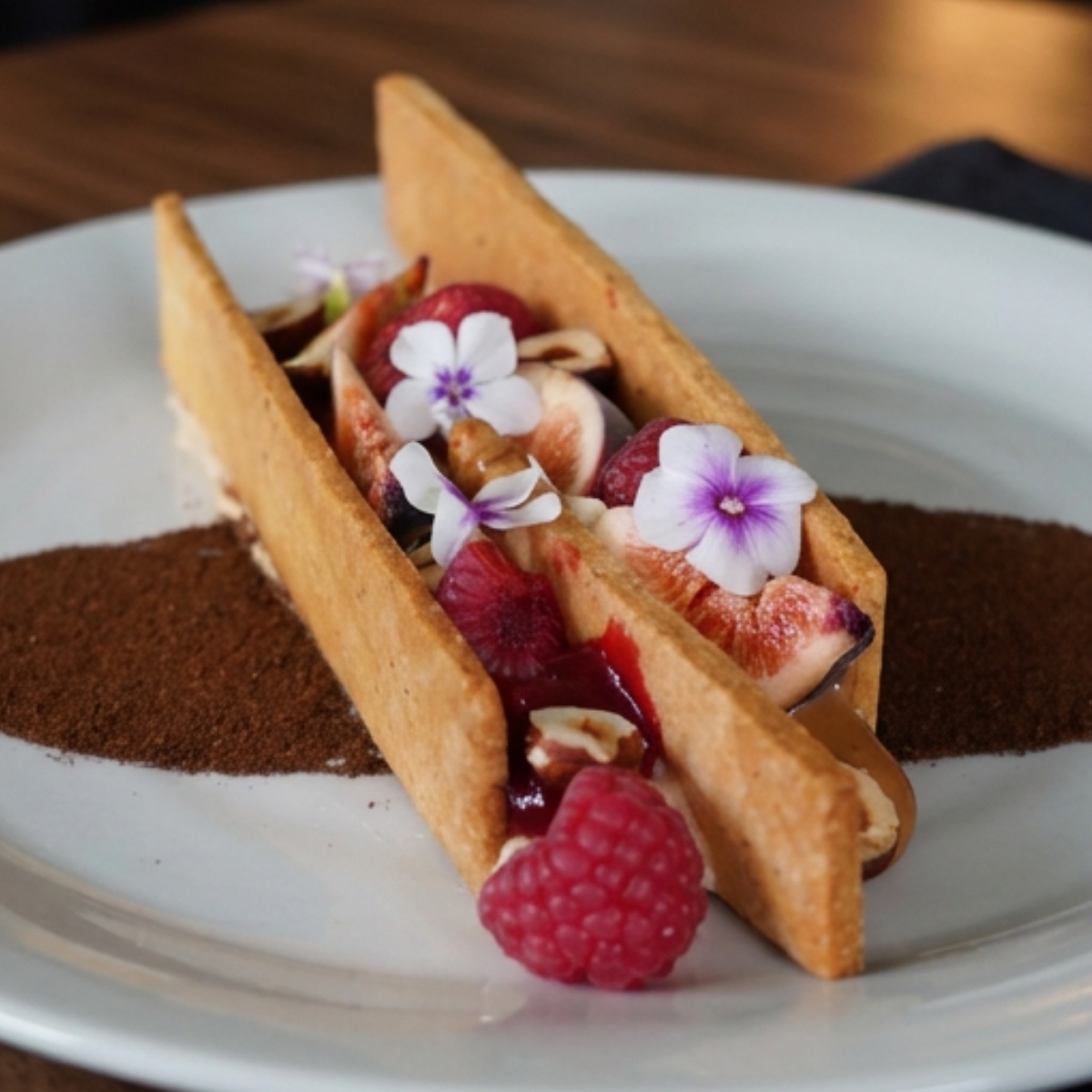
Plated Dessert · Fig, Raspberry, Hazelnut & Vanilla
A plated dessert inspired by a deconstructed tart, where the sweetness of fig and the acidity of raspberry meet the indulgence of hazelnut and the aromatic notes of vanilla.
Products used:
1. Raspberry Gel
Ingredients
- 200 g raspberry purée
- 20 g caster sugar
- 5 g lemon juice
- 5 g NH pectin
Method
- Pour the raspberry purée into a saucepan and gently warm it.
- Thoroughly mix the caster sugar with the NH pectin.
- Gradually add this mixture to the warmed purée, sprinkling it in while whisking to prevent lumps from forming.
- Bring to the boil and maintain a brief boil to activate the pectin.
- Add the lemon juice and mix thoroughly.
- Transfer to a container and leave to cool in the refrigerator until fully set.
- Just before use, blend with a hand blender until perfectly smooth, homogeneous and soft enough to pipe.
2. Fine Hazelnut Shortbread
Ingredients
- 150 g unsalted butter, 82% fat
- 95 g icing sugar
- 2 g Welsh Fleur de Sel
- 50 g roasted hazelnuts, ground
- 25 g almond powder
- 55 g whole egg
- 250 g T55 flour
- 5 g Bourbon Vanilla Powder
Method
- Using the paddle attachment, lightly cream the butter and icing sugar in the bowl of a stand mixer.
- Add the almond powder, ground roasted hazelnuts, Welsh Fleur de Sel and Bourbon Vanilla Powder.
- Add the flour and mix until a sandy, homogeneous texture is obtained.
- Add the whole egg and mix briefly, only until fully incorporated. Do not overwork the dough to limit gluten development.
- Roll the dough between two sheets of baking paper to a maximum thickness of 1.5 mm.
- Refrigerate until firm.
- Cut into rectangles 3 to 4 cm wide, with varying lengths of 10 to 15 cm.
- Bake the shortbread rectangles in a preheated oven until evenly golden brown and crisp.
- Leave to cool completely on a wire rack before assembling.
- Plating note: varying the lengths creates an irregular, dynamic geometric composition on the plate.
3. Intense Hazelnut Cream
Ingredients
- 250 g milk
- 45 g egg yolks
- 40 g caster sugar
- 18 g cornflour
- 2.5 g gelatine
- 20 g unsalted butter
- 30 g hazelnut praline
- 30 g hazelnut paste
- 150 g double cream, 35% fat
Method
- Heat the infused milk.
- In a mixing bowl, whisk the egg yolks and sugar until pale.
- Add the cornflour and mix until smooth.
- Gradually pour the hot milk over the yolk, sugar and cornflour mixture while whisking.
- Return to the saucepan and cook like a pastry cream, whisking constantly until thickened and the mixture reaches its first boil.
- Remove from the heat and add the previously rehydrated and squeezed gelatine.
- Add the butter, hazelnut praline and hazelnut paste.
- Blend with a hand blender until perfectly smooth and homogeneous.
- Cover with cling film in contact with the surface and refrigerate.
- Whip the 35% fat cream to a soft consistency.
- Once the hazelnut base has cooled and is perfectly smooth, gently fold in the whipped cream.
- Transfer to a piping bag fitted with the appropriate nozzle and refrigerate until assembly.
Method
- Spread the hazelnuts on a baking tray and roast at 150–160 °C for 15 to 20 minutes, until evenly coloured and intensely aromatic.
- In a heavy-based saucepan, make a dry caramel with the sugar.
- Cook until a light amber colour is obtained.
- Immediately pour the caramel over the roasted hazelnuts.
- Leave to cool completely until the caramel has crystallised and hardened.
- Break the mixture into pieces and place in a Robot-Coupe or another sufficiently powerful food processor.
- Blend gradually, scraping down the sides regularly.
- The mixture will successively go through the following stages: pieces → powder → paste → fluid praline.
- Add the Welsh Fleur de Sel.
- Continue blending until the praline is perfectly smooth, fluid and glossy.
- Transfer to an airtight container.
5. Assembly & Plating
Preparing the Plate
Method
- Bake the shortbread rectangles and leave them to cool completely.
- Place a leaf-shaped stencil on a flat plate.
- Dust evenly with Bourbon Vanilla Powder to create a dark, graphic pattern.
- Carefully remove the stencil, preserving the sharpness of the pattern.
- Using a knife or small spatula, visually define the plating axes along which the three shortbread rectangles will be positioned.
Plating
Method
- Pipe a regular line of intense hazelnut cream onto the plate.
- Place the first shortbread rectangle vertically, securing both ends with the cream to create an architectural element.
- Repeat the process along the other two cream lines, using three rectangles of different lengths to create an asymmetrical and dynamic composition.
- Using a piping bag fitted with a fine nozzle, pipe dots of raspberry gel alternately along the cream lines.
- Then add dots of hazelnut praline, varying their diameter slightly to create rhythm in the plating.
- Finish with the fresh elements: fresh fig wedges, halved raspberries and edible flowers.
- Check the overall balance of the plate and maintain a clear visual distinction between the different elements.


