
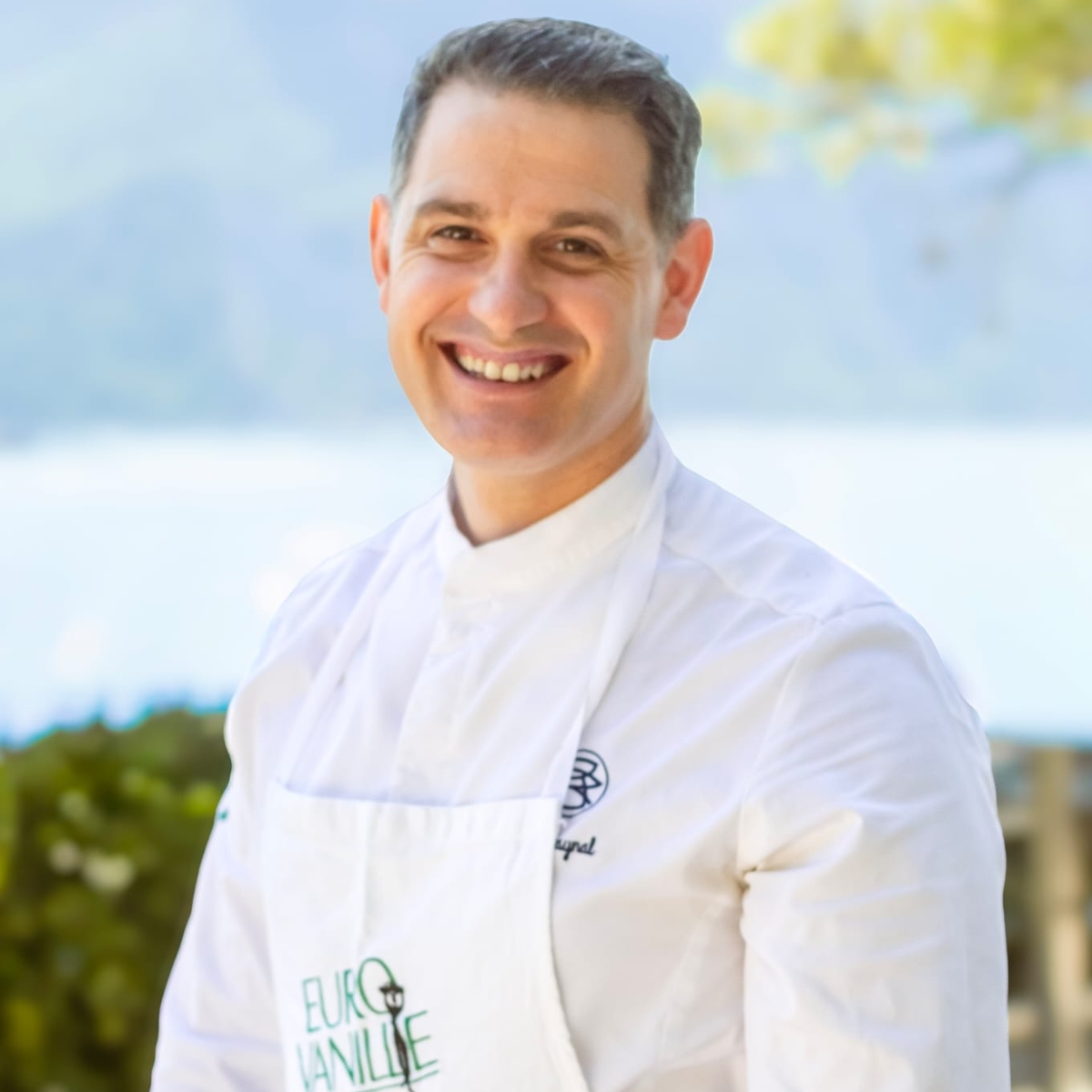
Interview with Kevin Raynal, Pastry Chef at Les Roches Blanches
Interview with Kevin Raynal, Pastry Chef at Les Roches Blanches
From Abbaye de la Celle to Les Roches Blanches in Cassis, Kevin Raynal has built his career as a Pastry Chef around a commitment to excellence, knowledge sharing and respect for the product. For the Valentine’s Day desserts, he joins forces with Eurovanille to share his vision of pastry-making, where every gesture matters.
Eurovanille
Could you tell us a bit about your background, from the start of your career?
Kevin RaynalI started at the age of 15. I did an apprenticeship in Aveyron, then a CAP in cooking, a CAP in chocolate-confectionery-ice cream, and a vocational baccalaureate in cooking. Before moving into pastry, I worked a lot in restaurants, in the kitchen, and I realised pastry was made for me. So I switched back to pastry. I started at 15, and today I’m 35: I’ve been doing pastry for over 25 years.
Eurovanille
What attracted you most to pastry, as opposed to cooking?
Kevin RaynalI find that in pastry, there is a lot of research and development around flavour and pairings. There’s also a lot of technique. And today, everything is evolving—techniques, flavours. There are so many things to learn, all the time.
Eurovanille
And what do you most enjoy doing in pastry?
Kevin RaynalI like working on everything. I’m just as passionate about bread as I am about viennoiserie, plated desserts, or ice creams. I’m curious about everything.
Eurovanille
What is your relationship with an ingredient like vanilla?
Kevin RaynalI like what it can bring in terms of flavour, in terms of aromatic range. When you crush it, it has flavour; when you toast it, it has flavour; when you grill it on a barbecue, it has a lot of flavour. You can work with it in many ways. You can use it in recipes in different forms: ice cream, frozen mousse, raw, pickles—and you can also eat it raw, as it is. There are so many ways to use it. And it’s extraordinary because, for us, vanilla is the caviar of pastry and cooking. So it’s extremely interesting to work with.
Eurovanille
How do you use vanilla?
Kevin RaynalI use vanilla powders, yes. For example, we make vanilla cakes: we use vanilla sugar with vanilla powder. We flavour the cake with that. As for pods, we use everything: once they’ve been used, we dry them, infuse them in a vanilla brown butter to add to the cake as well. So nothing is wasted: everything is transformed.
Eurovanille
If you could name your three favourite Eurovanille products, what would they be?
Kevin RaynalFirst, Cœur de Vanille, that’s for sure. I know it was designed more for cooked preparations, but when we make an ice cream with it, I find it has an incredible amount of flavour and I can’t do without it anymore. As soon as I run out, I have to order more. Even the head chef (at Abbaye de la Celle, editor’s note) really likes the aroma it gives to the ice cream.
Then there’s a pod I really like: Ugandan vanilla. I find it brings slightly woody and very fruity notes to what I make, and I use it a lot.
And then, the hazelnuts, and the vanilla paste too. I use the paste in biscuits, in gels (fruit gels), and I also use it to make vinegars.
Eurovanille
What would be your dream dessert—the one you’d love to put on the menu?
Kevin RaynalFor me, there is no perfect dessert. When I make desserts—when I finish them and taste them—I know it’s not perfect. There are always flaws, and I find that beautiful: making a dessert that still has imperfections. Mousses aren’t straight, piping—some dollops are a bit bigger than others. Ice creams start to sweat slightly…
But the dessert I’d really love to make is a small cake called, where I’m from, gâteau à la broche. My grandfather used to put Madagascar vanilla in it, and one day I’d really like to create a dessert based on vanilla gâteau à la broche.
My grandfather had lots of moulds for gâteau à la broche: the smallest are 6 cm high and 4 cm wide, and the largest is 2 metres high by 80 cm. I always told myself that one day, if I became a pastry chef, I would serve a gâteau à la broche dessert in a restaurant.
If I’ve achieved all this today—my training, my professional career—I owe it all to my grandfather. He was a baker and pastry chef. When I was little, I was always at his side, telling him: “Grandad, let me do things.” It’s partly thanks to him that I’m where I am today, and I thank him enormously. I think he would be proud of me.


